

How XR Technologies Are Reshaping Industrial L&D Programs
Industrial learning and development is under growing pressure to deliver faster skill readiness with fewer errors and consistent performance across sites.

Industrial learning and development is under growing pressure to deliver faster skill readiness with fewer errors and consistent performance across sites. Extended reality technologies are changing how organisations educate their employees because they allow them to learn on the job, making it a hands-on experience, and there is no risk of being put in a situation where the learning can go wrong. More and more organizations are turning to XR learning solutions as a means of closing the learning and application gap to ensure continued operations.
The Limitations of Traditional Learning & Development Models
Traditional L&D approaches struggle to address complexity, realism, and engagement in industrial environments.
1. One-Size-Fits-All Training Approaches
Traditional L&D solutions are very much dependent on standardized modules that cater to homogeneous learner requirements. This has then provided a gap in the industrial setting, as the operators, the technicians, and the supervisors have to work with systems of varying complexities. The status quo content does not respond to role working, equipment differences, or previous experience. The result is disproportionate acquisition of skills and time-to-competency.
2. Lack of Realistic Practice Environments
The procedures of the industrial training are usually, and in most cases, involve equipment or places where the learning process cannot be halted. This leads to a restricted practice or a mere theoretical practice. The learners cannot translate the procedures into action unless they are realistically rehearsed. There are errors in live operations that enhance downtime, rework, and safety incidents.
3. Low Engagement and Retention Rates
In passive learning formats, the amount of attention and retention of the knowledge is low. Research done regularly reveals that students forget whatever they read or listen to within days unless they put it into practice. This gap directly influences performance and compliance in industrial positions where situational awareness and muscle memory are highly essential.
Read More: Understanding World Anchors: The Key to Persistent AR Experiences
Understanding XR in Corporate Learning
XR introduces immersive, experiential methods that closely mirror real working conditions.
1. What is XR (AR, VR, MR)?
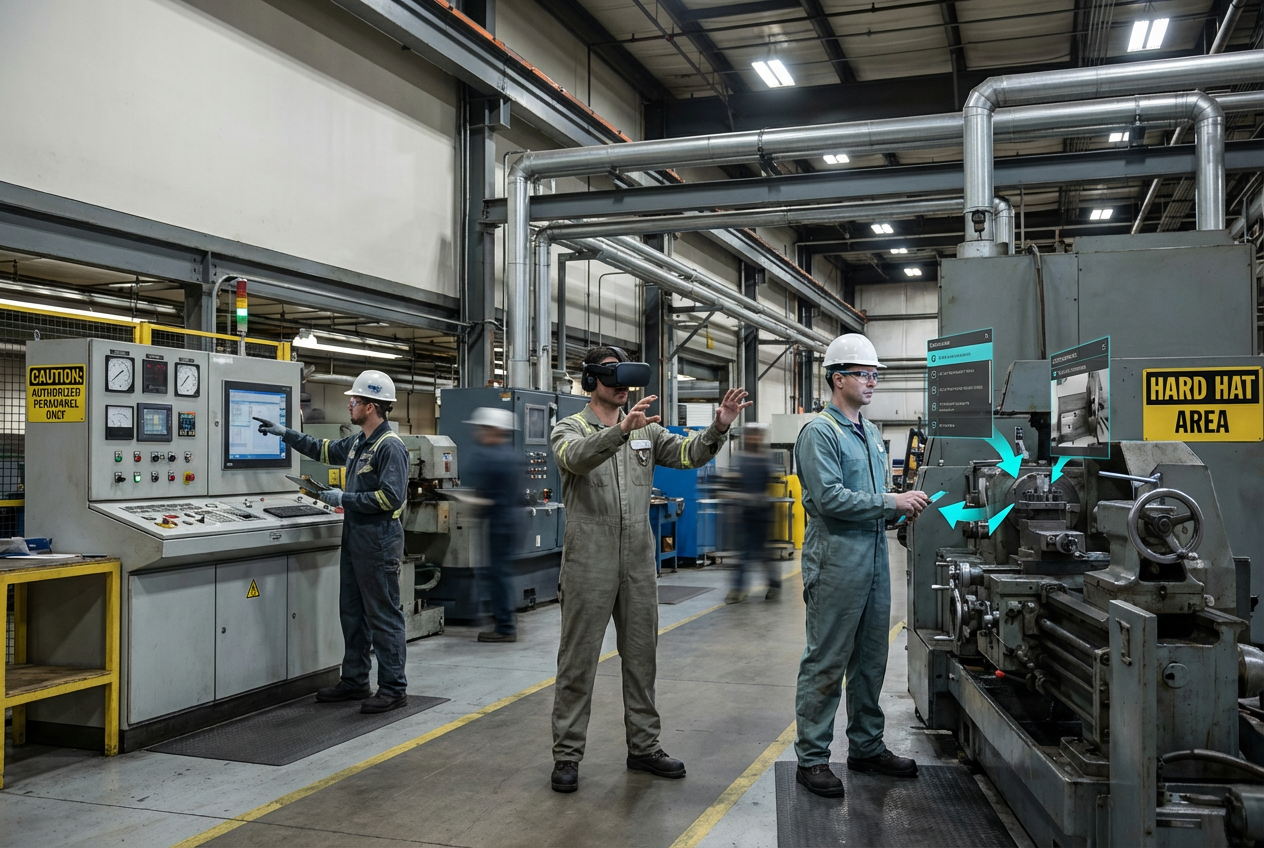
Extended reality is a broad phrase that incorporates virtual reality, augmented reality, and mixed reality. VR transports learners into environments that are completely simulated through the use of head-mounted displays. AR is a digital overlay of instructions, data, or visuals in the physical space by using smart glasses or mobile phones. MR is a combination of both, allowing digital objects to communicate with real objects in real-time.
2. How XR Enables Immersive and Experiential Learning
XR training works are created with the help of 3D models, physics engines, and real-time rendering. Students can touch equipment, go through a series of steps of procedures, and have consequences of actions occur to them within a controlled environment. Hand movements, direction gazes, and response time are recorded in sensor tracking. This turns the training into skill rehearsal and reinforces procedural memory, and makes a decision under realistic conditions.
Benefits of XR for Industrial L&D Teams
XR delivers measurable gains in skill mastery, personalization, and learner engagement.
1. Real-World Simulation for Skill Mastery
With XR, machines, tools, and workflows can be perfectly reproduced. The training scenarios may involve routine operations, infrequent failures, and emergencies that are physically hazardous or impractical. There is increased accuracy and confidence in tasks before these employees move their hands on genuine equipment via these simulations. Simulations may be well conforming to enterprise systems and safety standards when they are designed by a Top AR VR development company.
2. Personalized, Data-Driven Learning Paths
XR platforms capture the granular data of performance like error frequencies, completion time, and the point of hesitation. L&D teams may analyze this data in order to recognize skill gaps at either the individual or group level. This can then be dynamically implemented by adapting the training paths that may offer further practice where necessary. Companies that hire dedicated AR/VR developers can make the analytics dashboards interface with pre-existing learning management systems to enable them to continuously improve.
3. Enhanced Retention and Engagement Through Immersion
With immersive learning, one is able to gain knowledge at a high rate of retention since one uses several senses and makes a hands-on contribution. Learners are not spectators but agents in the situation. Gamified training development includes interactive features, scoring, and feedback loops, which encourage the training process and encourage positive behavior principles, thereby guaranteeing that correct behavior is acquired.
XR Use Cases Across Industries
XR adoption spans technical, operational, and behavioral training needs across sectors.
1. Manufacturing Process Training
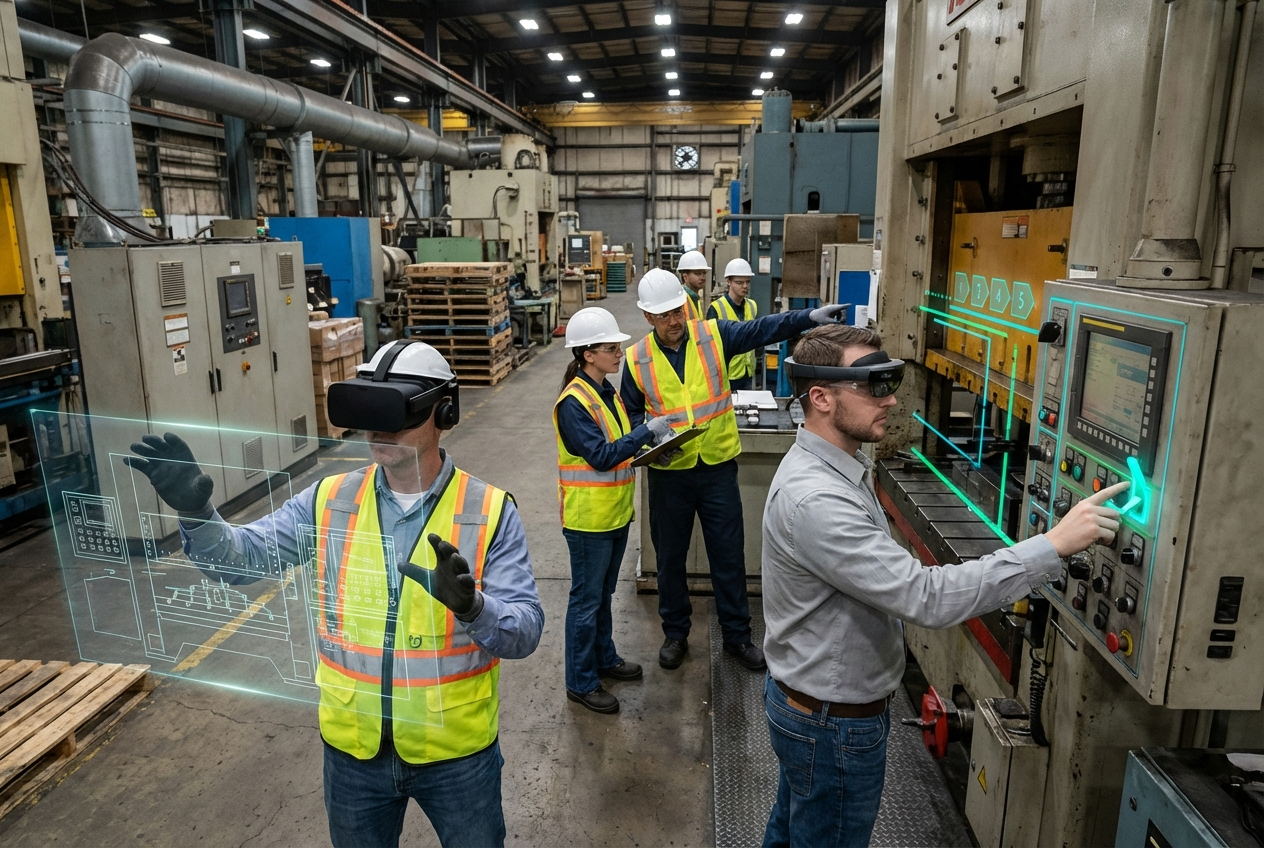
Aspirin Manufacturers with XR train assembly, quality inspection, and maintenance processes. Work instructions are able to be stored digitally, and they are imposed on equipment, and the operators are guided during work. VR simulations enable novice hires to train the intricate routines at a repetition level without interfering with production lines. Enterprise connection to Digital twin solutions for enterprises is what is needed to make sure that virtual models reflect real-time equipment combinations and process adaptations.
2. Aviation and Maintenance Programs
Precision and compliance in aviation and heavy maintenance are essential. XR allows technicians to train in inspection, part-replacement, and fault-diagnostic operations with the help of precise simulators of aircraft systems. Mixed reality headsets are able to show the values of the torque, wiring schematics, and checklists in real time when performing maintenance to minimize the number of errors and time spent on inspections.
3. Oil & Gas and Heavy Equipment Training
These businesses are in a risky safety environment. VR training gear familiarizes employees with entry into confined spaces, operating equipment, procedures during an emergency. The trainees can be shown real-world situations, like a pressure leak or failure in the system.
4. Safety, Quality, and Soft Skills Development
In addition to technical applications, XR is also utilized in risk drills, quality inspections, and personal development. The VR simulator can be used to simulate an incident investigation, leadership conversation, or compliance check.
Read More: Ways to Use AR and VR to Bridge the Workforce Skill Gap in Modern Enterprises
Implementing XR Learning Solutions in Enterprises
Strategic planning and execution are critical for scalable XR adoption.
1. Assess Training Needs and Objectives
The first stage, which involves successful XR adoption, is the identification of high-risk, high-cost, or high-frequency tasks. Learning objectives ought to be specificaboutn the kind of skills that have to be illustrated, not merely learned.
2. Choose a Reliable Development Partner for Custom XR Solutions
There is a need to have accurate modeling, system integration, and scalability in industrial XR. Collaboration with the established developers guarantees the ability to connect with the enterprise hardware, data security requirements, and the available digital infrastructure.
3. Scale XR Deployment Across Departments and Locations
Today's XR system is able to enable centralized content management and off-site updates. Modeling modules may be placed in locations while being consistent. To track workforce preparedness and internationalize the excellent practice, emerging performance data in various workplaces can be consolidated.
Conclusion
Enterprises are becoming more business intelligent through extended reality in building skills, reducing risk, and enhancing operational performance. XR integrates immersive simulation, real-time feedback, and data-driven insights to eliminate the fundamental flaws of the conventional L&D models. With increasingly complex industrial systems, XR will be the backbone of workforce development, allowing organizations to train smarter, safer, and at scale.