

How VR Safety Training Reduces Workplace Accidents in High-Risk Industries
The nature of high-risk industries is that the occurrence of one human error may lead to injury, damage to equipment, the imposition of regulatory fines, or closure. Conventional safety teaching techniques are not effective in imitating world complexity, diversity, and stress.

The nature of high-risk industries is that the occurrence of one human error may lead to injury, damage to equipment, the imposition of regulatory fines, or closure. Conventional safety teaching techniques are not effective in imitating world complexity, diversity, and stress. With businesses going digital in their business operations, immersive learning has emerged as an effective risk mitigation strategy. The Virtual Reality simulation systems of safety training enable organizations to expose workers to dangerous situations in a controlled, measurable, and repeatable environment. VR is no longer an experiment to CTOs and safety leaders. It is part of the industrial risk management plan.
The Rising Safety Challenges in High-Risk Industries
Let’s understand why existing safety systems fail to scale with operational risk.
Common Causes of Workplace Accidents
Accidents occurring at work are usually the result of foreseen points of failure as opposed to unforeseen exceptions. These are a lack of hazard recognition, delayed reaction, inability to form procedural memory, and inconsistent adherence. The employees in manufacturing, construction, and energy sectors work on heavy machines, in tight places, and with dangerous substances. The larger the operations, the more the variability and the higher the intensity of incidents, unless training systems can also change.
Limitations of Traditional Safety Training
Classroom instructional methods and video modules lack high retention and low contextual transfer. Employees can be intellectually learned but cannot put rules into practice when the pressure is on. Physical mock exercises are not only expensive but also logistically difficult and may not be standardized across sites. There is restricted data capture, therefore it is difficult to evaluate the readiness of individuals or gaps in the systems. Such restrictions cause organizations to fail in bridging the gap between training and real-life performance.
Read More: Why VR Works for Training
Why VR Safety Training is the Game-Changer
This section explains how immersive systems overcome the core weaknesses of legacy training.
Immersive Simulations for Hazard Recognition
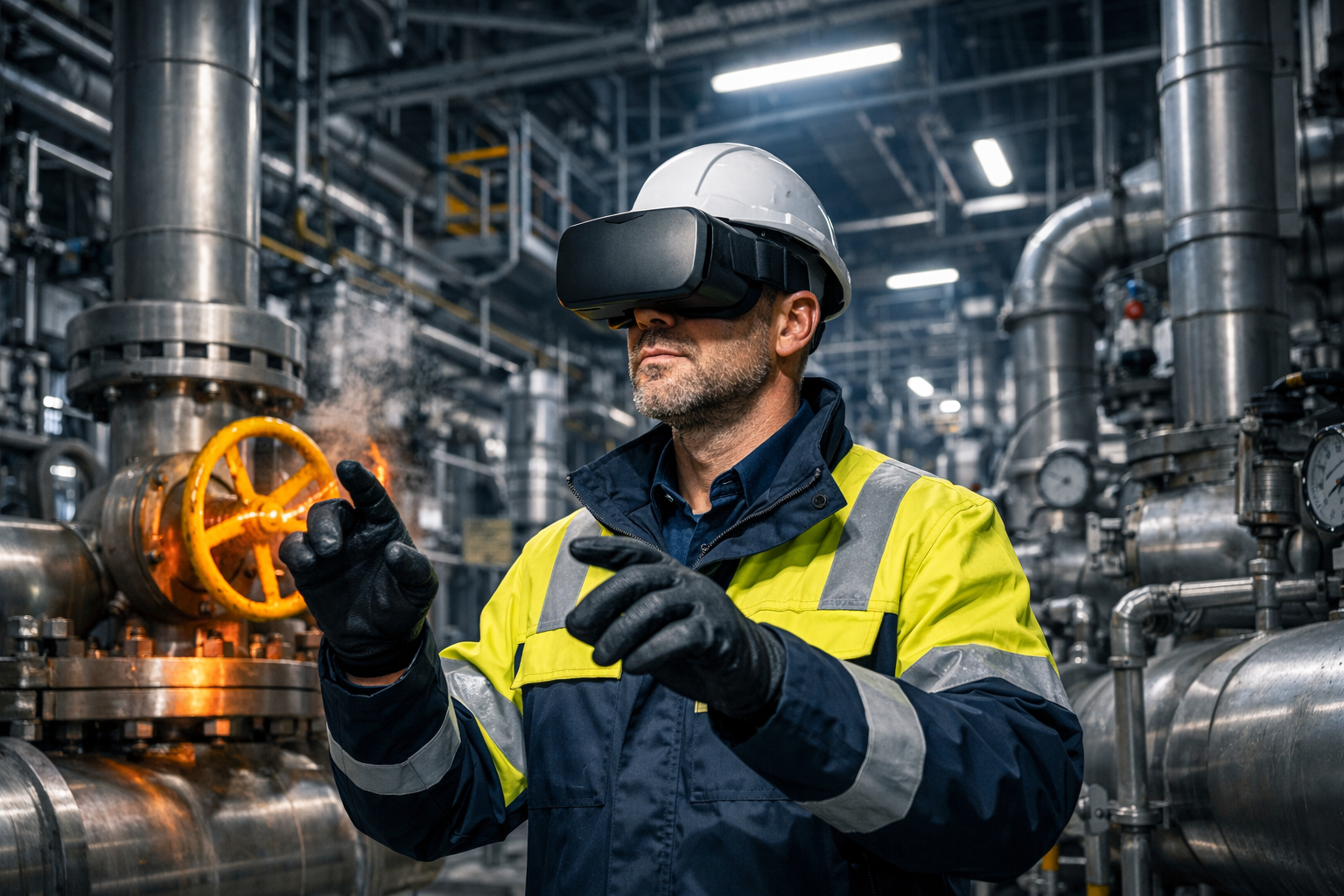
VR simulates industrial environments in both space and behavior. The trainees move through equipment plans, tracked machineries and running operational indicators. Hazards are dynamically created depending on the user's choices using computer vision, physics engines, and real-time rendering. This is perceptual awareness training, not memorization. Gaze tracking, response latency, and decision paths are also recorded over VR simulation platforms.
Realistic, Risk-Free Learning Environments
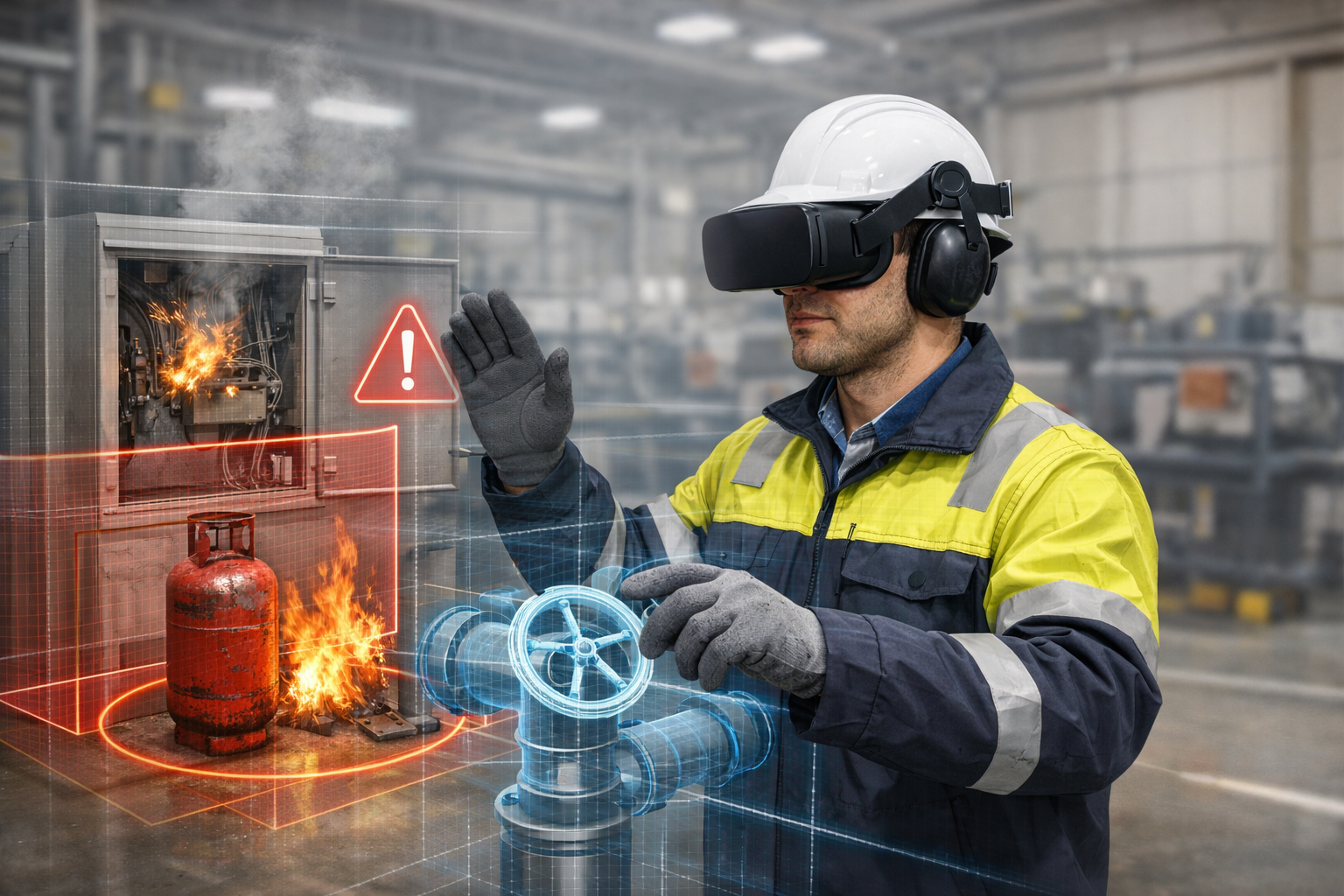
The trainees have the capability of experiencing fires, equipment breakdowns, or structural collapse without being exposed to them. Simulation engines incorporate actual operational data in the form of SOPs, CAD models, and machine telemetry. This guarantees the authenticity of scenarios and also the safety. In CTOs, this gives them less liability and opens them to rare but highly significant incidents.
Building Muscle Memory Through Repetition
With VR, repetition can be conducted at a high frequency without having to wear hardware or disrupt the operations. Haptic, Motion tracking, and spatial audio enhance sensorimotor learning. In the meantime, right answers become automatic. This has immediate technological effects on the response time and decision-making under an actual emergency. The concept of gamified training development also enhances the level of engagement and completion within the distributed teams.
Industry Applications of VR Safety Training
This section demonstrates how VR training adapts to sector-specific risk profiles.
Manufacturing and Heavy Equipment Handling
Such training as lockout-tagout, manufacturing training on the. Virtual machines' operation and maintenance drills are beneficial in manufacturing. Virtual reality training for manufacturing enables employees to train on startup, closing down, and managing faults of machines based on the use of digital twins. The MES and PLM system integration enables harmonization of live production processes. Any error is recorded, examined and corrected before employees work on physical assets.
Oil & Gas and Energy Operations
The areas of energy activities are narrowed to explosive environments and high-pressure systems. VR looks like offshore rigs, refineries, and substations with real physics and emergency runaway. Employees are drilled on evacuation routes, valve control, and shutdown under stress. Such systems are more commonly connected with safety management software to document compliance and prepare audits.
Construction and Mining Safety Training
Construction and mining sites keep changing every day, and thus, it is hard to come up with standardized training. VR scenarios simulate excavation risks, structural stability, and automobile collisions. At the training level, trainees are taught how to judge space and make risk predictions before taking them to live sites.
Aviation and Maintenance Drills
Maintenance in the aviation industry must be highly accurate in its procedures. VR systems help in aircraft inspection, engine maintenance, and ground handling operations. Simulations resemble aircraft schematics and fault conditions. Performance is also the input of certification tracking systems, which guarantee regulatory conformity and skill certification.
Read More: How Virtual Reality is Revolutionizing Technician and Aviation Training
Business Benefits for Enterprises
Let’s look at the measurable organizational impact of immersive safety systems.
Reduced Accidents and Compliance Violations
Companies using VR training suffer a quantifiable decline in incident rates and near-misses. There is alignment of the procedural aspect across different teams because of consistent scenario delivery. The automated reporting makes it easier to conduct regulatory audits and documentation on compliance. This backs the enterprise risk reduction ambitions on a broad scale.
Improved Employee Awareness and Retention
Immersive learning enhances the retention of knowledge as it involves activation of the multiple cognitive systems. There is an increased situational awareness and trust in employees. Interactive design enhances the rate of training completion. The effect of this is a better-equipped workforce and less time on board.
Lower Insurance and Operational Costs
Reduced accidents will mean there will be less insurance premiums, less downtime, and equipment will be damaged less. VR training allows for the decrease in the use of physical models and instructor-based training. In the case of large businesses, ROI is achieved in both direct cost savings and loss avoidance.
Implementing VR Safety Training Programs
This section focuses on execution strategy and technology decision-making.
Identify High-Risk Scenarios for Simulation
Incident analysis and risk prioritization are the starting features of implementation. Scenario selection is based on historical data regarding accidents, near-miss data, and assessment of hazards. Target high-frequency and high-severity events to have maximum impact. The simulation needs to be in line with operational reality as opposed to hypothetical risks.
Choose the Right Partner and Technology Stack
The deployment cannot be successful without knowledge of simulation designing, system integration, and UX. This guarantees scalability, security, and performance by working with a Top AR VR development company. Compatibility of hardware, engine architecture, analytics, and LMS integration should be looked at by CTOs. It is also common to find many businesses contracting professional AR/VR developers on a long-term basis to perform customization and development of internal capability, and hire dedicated AR/VR developers.
Measure Training Effectiveness and ROI
VR systems create extensive performance indicators. These are the error rates, response time, and scenario completion data. Making training outcomes related to reducing incidences gives explicit ROI awareness. Recurrent training on analytics guarantees relevance in training as the operation develops.
Conclusion
VR safety training is a paradigm change in the approach of high-risk industries to workforce preparedness. VR safety training simulation does not become an add-on to technology leaders. It is a critical strategic safety infrastructure investment, which is a human performance correspondence to complex industrial systems.