

How Virtual Reality is Revolutionizing Technician and Aviation Training
Virtual reality is changing the way technicians and aviation specialists learn their trade. Instead of classroom lectures or manuals, they now train in realistic digital environments that are fully immersive.

Virtual reality is changing the way technicians and aviation specialists learn their trade. Instead of classroom lectures or manuals, they now train in realistic digital environments that are fully immersive. Such training in simulation allows them to safely practice complex tasks, reduce mistakes, and build confidence. To enterprises, VR offers a highly scalable way of upskilling teams more cost-effectively. In highly regulated fields, such as aviation or high-risk technical work, VR training is not a nicety-it's fast becoming a must-have tool for improving safety, competence, and operational performance.
The Evolving Training Needs in Technical and Aviation Fields
First, it's critical to understand the challenges those industries face and how VR can answer them.
What are Industry Problems
In manufacturing, energy, and service industries, technicians often train using physical equipment. This can have several disadvantages: machines are not always available for training; downtime is very costly; and training on live systems can be dangerous. According to ATS Industrial Automation, making machines unavailable for training disrupts production; also, conventional training commonly burdens already stretched experts.
Moreover, traditional training does not achieve any consistency: different trainers, different locations, and variable content lead to uneven skill levels. Retention, on top of that, is weak; lectures, slides, or videos are passive, with many learners forgetting key details when under pressure.
The Opportunity for Transformation in Aviation
Aviation training is particularly challenging. There are high-risk procedures and emergency protocols to be learned by all pilots, cabin crew, and ground staff, in addition to the mechanical systems that are very complex. Physical flight simulators are few and very costly. Maintenance crews have to practice inspections, fault diagnosis, and repairs but working on real aircraft for training purposes is dangerous and expensive. This environment makes aviation ideal for VR, where virtual aircraft, realistic cockpits, and detailed maintenance systems can be simulated without disrupting real flight operations or posing any risk to safety.
How Virtual Reality Is Transforming Technical Training
VR addresses a number of the traditional limitations in technician training.
Issues with Traditional Methods
Traditional technician training methods include classroom lectures, physical equipment, and shadowing of experienced workers. These practices are slow, risky, and often not standardised. There's also the question of scale-it's hard to consistently train many people across different locations. Safety is a major concern, too, because hands-on practice may sometimes mean working with hazardous machinery.
Modern VR Solutions in Aviation Training
Here's how VR solves these issues through powerful modern tools:
● Immersive, Hands-On Learning for Realistic Scenarios: In VR, technicians operate virtual machines just as they would in real life. They can assemble parts, work with tools, and follow real workflows-all in a simulation. This type of interactive VR training for technicians gives learners real-world muscle memory without risking actual equipment.
● Safety Without Risk – Virtual Environments for Critical Operations: VR allows trainees to practice dangerous tasks-for example, working on hot machinery or doing lockout / tagout procedures-with no physical risk whatsoever. The virtual environment can repeat high-risk scenarios over and over again to help build confidence and competence in trainees.
● Consistency and Standardisation Across Training Programs: Because the VR modules are digital, the same scenario, instructions, and assessment can be delivered to every trainee. This makes sure that the quality of training doesn't differ between trainers or locations.
● And More: A gamified training development enhances VR by adding challenges, feedback, and scoring to further enhance engagement and motivation. These game-like features foster repetition for mastery and active learning.
Read More: Latency Challenges in Real-Time VR Training and Effective Solutions
How VR Is Changing Aviation Training
It's not only about pilots; in aviation, VR is changing the face of maintenance, safety, and crew training.
Simulated Flight Environments for Pilots and Crew
VR-based flight simulators can create cockpits and full-flight situations at a fraction of the cost of physical ones. Trainees may practice take-offs, landings, system failures, and emergency procedures without risk. These simulations help pilots build muscle memory, situational awareness, and decision-making skills before they ever climb into a real aircraft.
Maintenance and Ground Staff Training
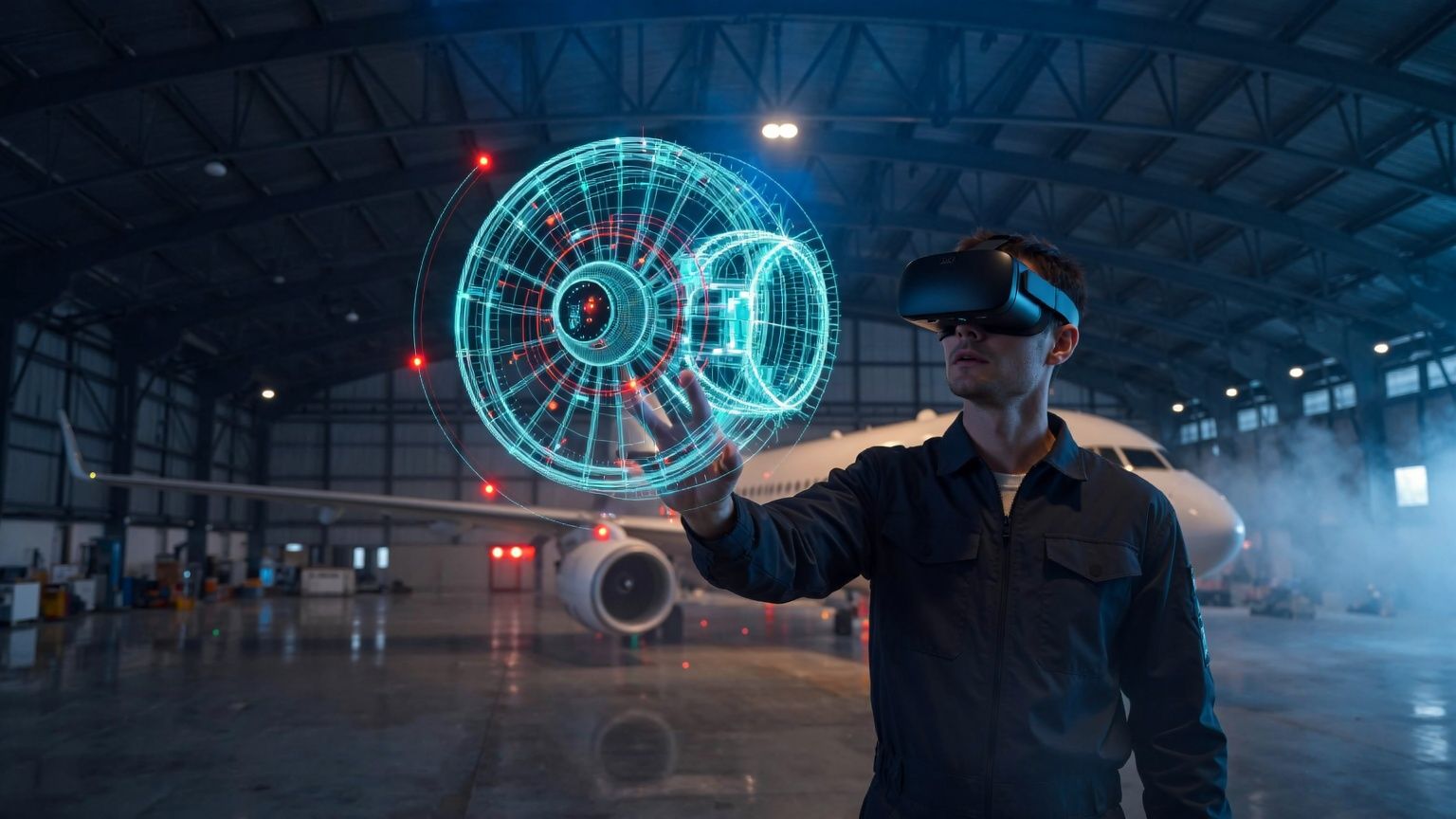
Technicians and ground staff use VR to simulate aircraft maintenance tasks such as inspections, fault repairs, and system diagnoses. According to a study of 100 aviation students, VR training increased post-training competency scores from 65.4% to 87.6%, a significant gain. In addition, participants in such training reported high engagement: 92% felt more focused and motivated.
Emergency Procedure and Safety Drills
VR also allows practice of emergency protocols by crew and ground personnel for such situations as engine fires, rapid decompression, evacuations, and ground collision scenarios. VR training for aviation industry modules prepares them through these virtual drills for rare but critical events. Because the simulation is risk-free, learners can repeat drills many times until they reach high mastery; this helps them build both proficiency and confidence in high-stress, high-risk procedures.
How VR Empowers Technicians Across Industries
VR training provides great benefits to technical teams in manufacturing, utilities, and industrial sectors.
Realistic Equipment Handling and Maintenance Practice
It allows technicians to interact with machines, tools, and industrial systems in virtual settings. Realistic simulation of physics and behaviour offers realistic training in assembly, dismantling, repair, and maintenance. This real-like training helps them internalise procedures without touching real and often expensive equipment.
Step-by-Step Troubleshooting and Assembly Guidance
VR modules thus guide the user step by step. Once the trainees commit errors in them, they get instant feedback or visual cues of correct steps, helping them realise where they went wrong and how to fix it. Over time, this builds a habit of methodical troubleshooting and careful assembly.
Measuring Skill Competency and Error Reduction
VR training can be instrumented: it tracks how many times someone makes a mistake, how long they take tasks, and how they recover. This gives trainers clear metrics on competence, progress, and error trends. A study found that implementing VR safety training resulted in a 43% reduction in lost time due to injuries. Meanwhile, industry leaders like Ultratech Cement reported a 45% decrease in safety incidents across 55 plants after using VR simulations.
Read More: Revolutionizing Training and Simulation with VR Technology
Implementing VR Training in Enterprise Programs
Effective deployment of VR training requires strategy, planning, and measurement.
Identify Training Areas Suited for VR Simulation
Start by mapping out the tasks and roles where VR can yield the most value. Look for high-risk operations, repeatable tasks, or areas where traditional training costs are inconsistent. Using a VR safety training simulation is particularly valuable for aviation tasks such as maintenance procedures or emergency drills. In technical fields, the focus should be on assembly, maintenance, or safety-critical tasks.
Scale and Measure Impact of Training
After the pilot program, collect data regarding learning outcomes, error reduction, time to proficiency, and engagement. These metrics will be useful in scaling VR training across the enterprise. With consistent measurement, you will have all the reasons to scale VR to more teams. Second, track your ROI by comparing training costs, a reduction in accidents, and productivity improvements. Partnering with a Top AR VR development company will help build scalable, high-quality VR modules tailored for your specific needs.
Conclusion
VR is transforming the way technicians and professionals in this field are trained. It offers fully immersive and risk-free learning environments that simulate conditions found in the real world. VR training increases safety, standardises training, and speeds up the development of skills. Through realistic simulations, from cockpit drills to machine maintenance, builds competence, confidence, and operational readiness. For companies serious about workforce excellence, adopting VR training isn't forward-thinking but rather essential.