

How Virtual Reality Accelerates Onboarding for Complex Industrial Roles
The concept of virtual reality is quickly changing complex industrial jobs, enabling new employees to acquire on-the-job experience more quickly.

The concept of virtual reality is quickly changing complex industrial jobs, enabling new employees to acquire on-the-job experience more quickly. Research indicates that VR can save up to 60% of onboarding time and increase retention by 75%, helping new hires achieve full productivity. Therefore, in case you also want to implement VR training for technician then partnering with AuraInteract will provide you the opportunity to accelerate onboarding for complex industrial jobs .
Challenges of Onboarding in Complex Industrial Environments
The obstacles explained below are intended to demonstrate the inability of conventional onboarding in complicated industrial environments and the necessity of improved approaches to faster preparation and performance.
Steep Learning Curves and High Error Risks
Industrial onboarding may entail the learning of complex machinery, process control, and safety measures. New hires are exposed to steep learning curves, which makes them take longer to be productive and a higher risk of making mistakes without hands-on training. Most organisations continue to use old classroom or shadowing approaches that can stretch the time-to-competency greatly beyond three months, where around 29% of employees consider themselves ready after the onboarding process. The gap highlights the inability of complex skills and tacit knowledge to be learned without more enriched training techniques.
Limited Access to Equipment and Mentors
Industrial job roles are usually demanding, requiring experienced mentors and knowledge of specialised equipment for advanced learning. But the companies are facing problems with onboarding because of infrastructure issues, such as equipment, digital systems, and training materials. New workers without sustained mentor support might not get the feedback and hands-on experience in a timely manner, which slows acquisition of competence in high-risk environments.
Read More: How VR Safety Training Reduces Workplace Accidents in High-Risk Industries
Why Virtual Reality is Transforming Industrial Onboarding
Complex industrial workforces are being redefined by virtual reality, where technical roles are being onboarded with a quantifiable business impact. VR enhances learning and retention and reduces risks by simulating real work conditions without physical harm.
Immersive Role-Based Training Simulations
VR training simulation enables the trainees to learn job-specific tasks through repetition before getting into the real operations, and this drastically reduces the learning curve. VR students can complete the training process four times faster than in conventional training, enhancing confidence and competence. The use of VR modules in industrial companies helps to minimise onboarding time.
Safe Practice for High-Risk Tasks
VR enables a risk-free environment for the trainees to simulate complex and risky processes, like using machinery or emergency policies in real-life hazardous industrial conditions. This minimizes the risk of on-site training and enhances the awareness of hazards and compliance with procedures in a manner that does not put the personnel at risk of actual harm.
Standardised Knowledge Transfer Across Locations
VR also means uniform quality training and delivery of content at all the distributed locations without any differences due to different teachers or facility constraints. Firms that apply VR experience increase trainee engagement and retention compared to traditional methods. These evidence-based tendencies highlight how VR can be used in industrial onboarding, safety, productivity, and increased global knowledge congruency.
Use Cases of VR in Industrial Onboarding
The VR is fast gaining popularity as a component of the industrial learning strategies, allowing the scaling and consistent training of the workforce across several sectors. As the VR training market goes global and large companies are speeding up their adoption, firms are turning to immersive simulations on a large scale to enhance readiness, safety, and performance.
Manufacturing and Assembly Line Roles
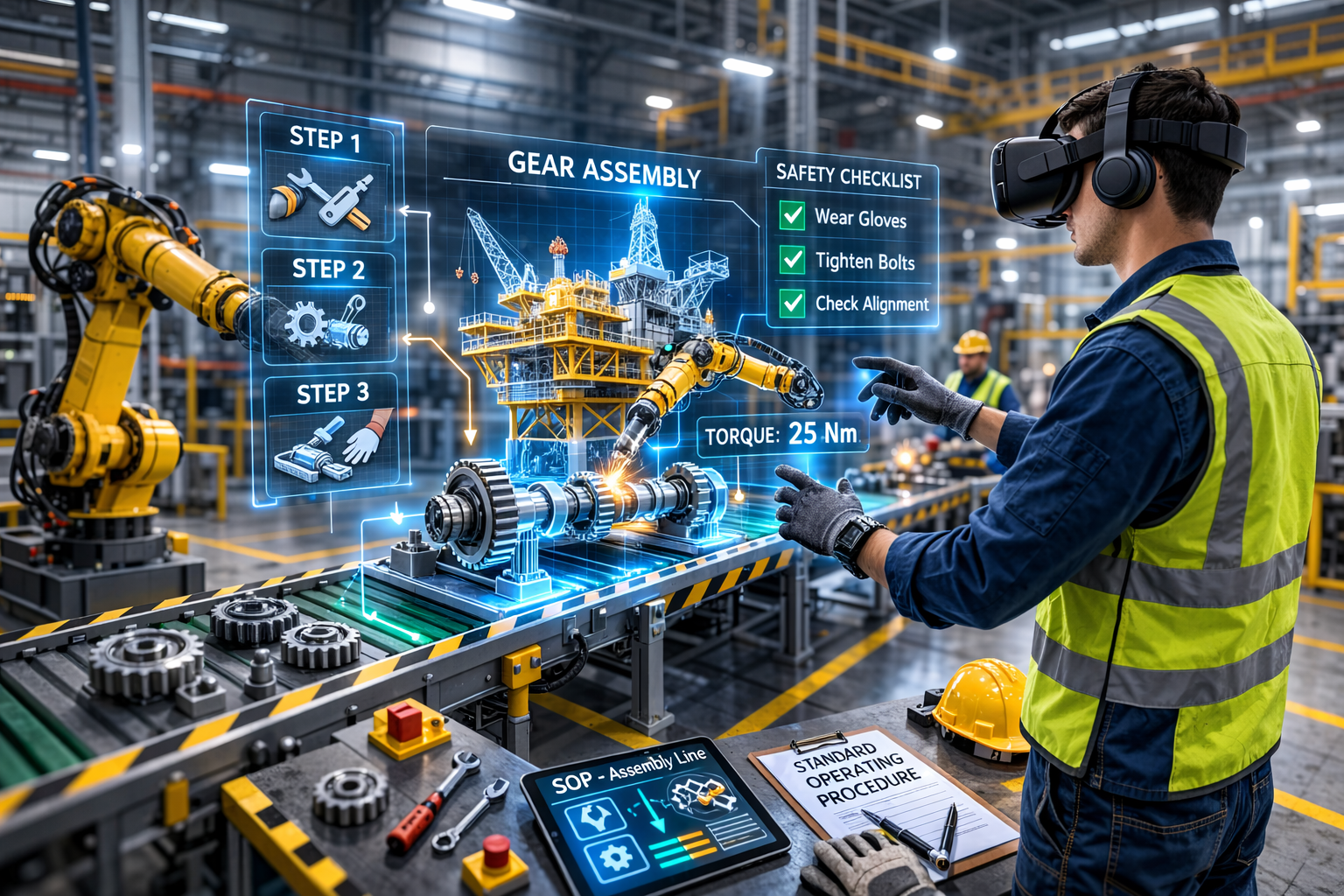
Virtual reality training for manufacturing helps companies to upskill employees on assembly line operations and machine connections in an interactive, simulated environment. This practical training enhances retention, minimizes possibility of issues on the floor, and expedites the time-to-competency without causing time wastage in production. VR aids in the rehearsal of complex tasks under controlled conditions and helps workers to understand the intricate work processes more quickly.
Maintenance and Field Technician Onboarding
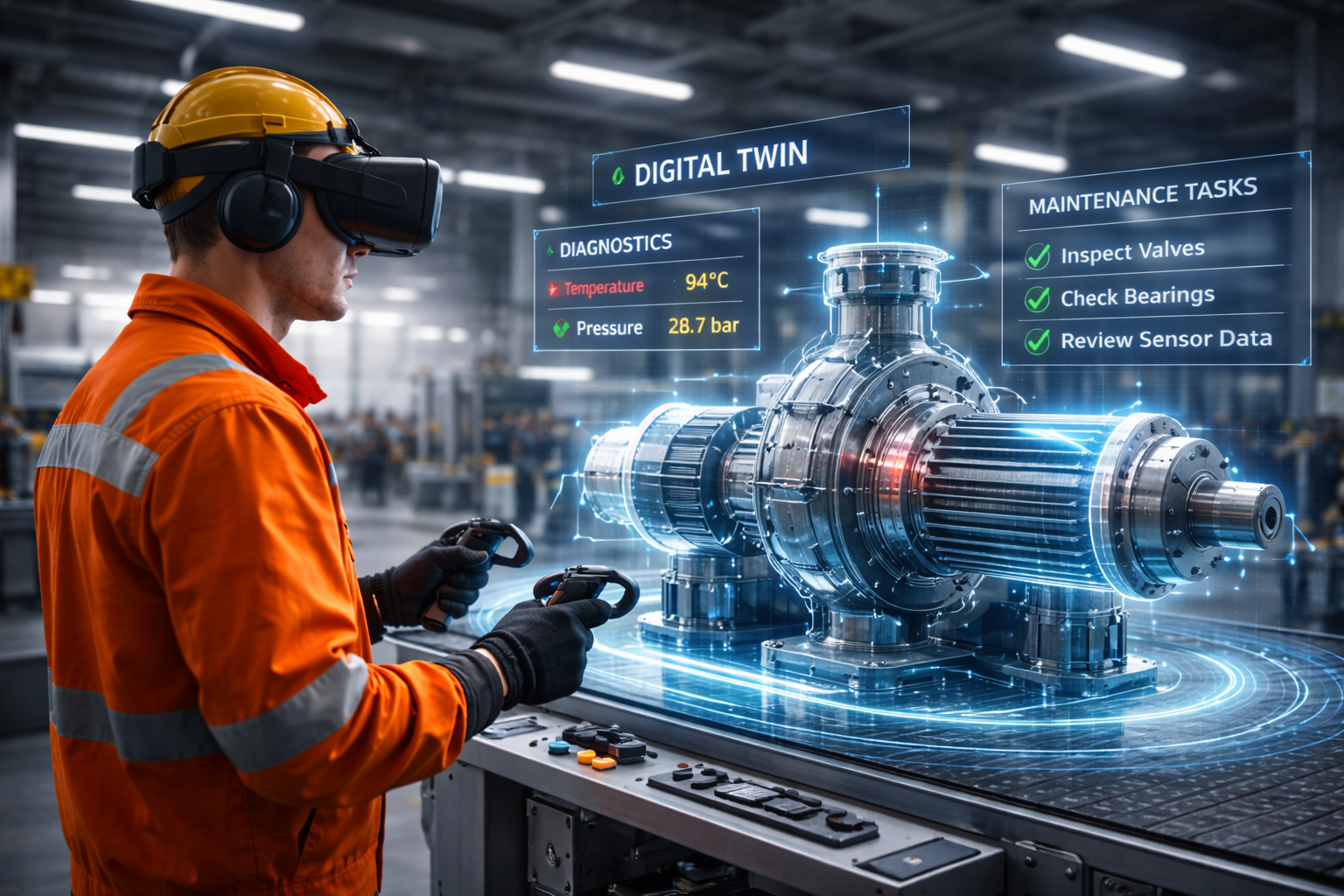
VR simulation provides maintenance technicians the opportunity to practice diagnostics, maintenance sequences, and troubleshooting on the virtual models of the heavy equipment. Immersive practice reduces reliance on physical resources and instructors in initial training stages and saves onboarding duration, particularly in distributed operations where a limited number of people can access equipment. Over 62 percent of Fortune 500 businesses are currently operating VR or AR pilot programs, and VR implementation businesses have cut error rates by 30 percent and enhanced knowledge retention by 20 percent.
Safety and Compliance Training
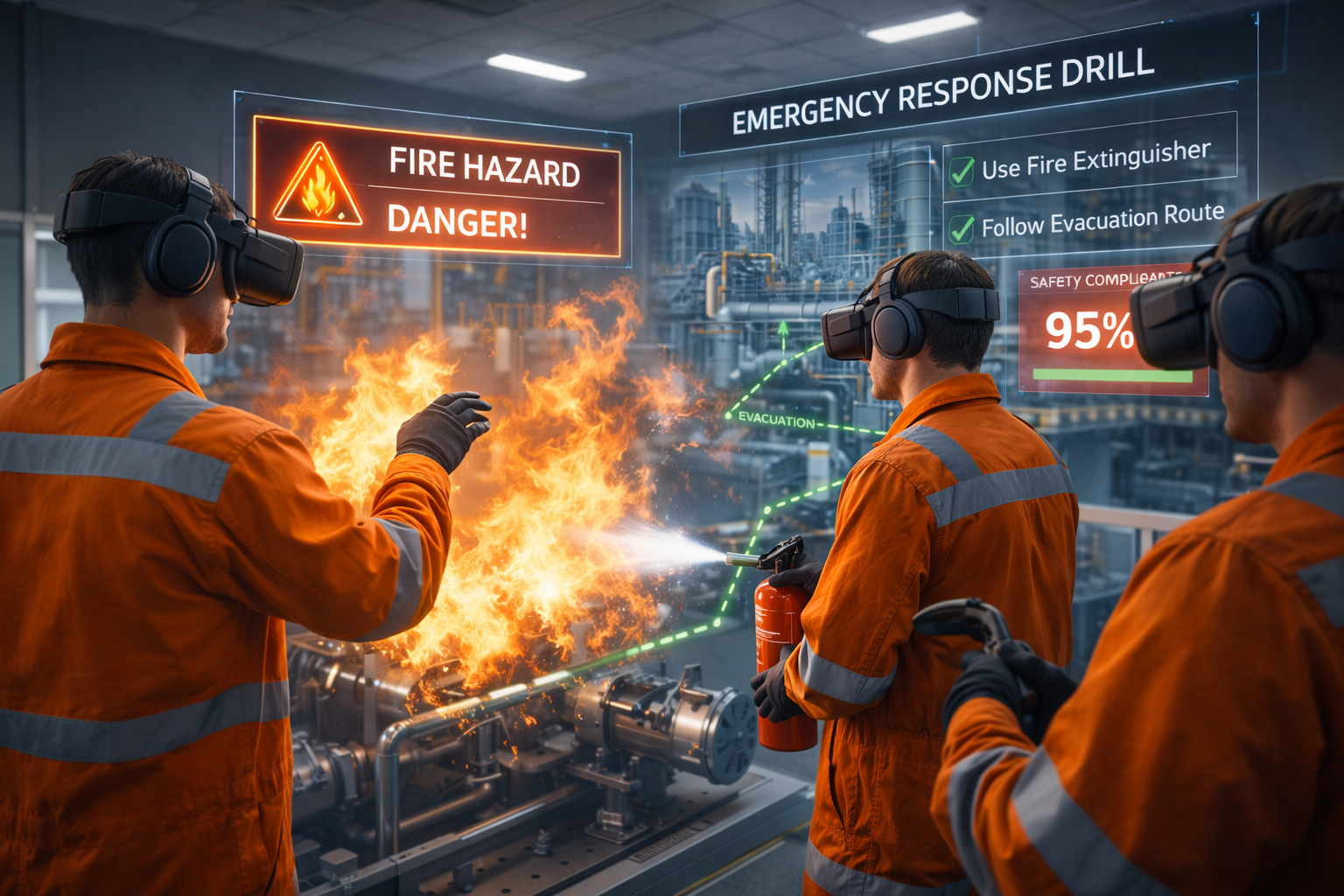
Dangerous training conditions, like emergency management, hazard identification, and safety measures execution, can be trained in VR in a safe environment. Industrial trainers are introducing real-time safety training modules into virtual worlds to standardize training.
Equipment Familiarisation and SOP Training
VR increases the speed at which individuals are familiar with machines, tools, and standard operating procedures (SOPs) through repeatable, scenario-based, and location-uniform practice. These applications illustrate how immersive learning transforms industrial onboarding to improve skill acquisition, minimize risk, and scale to deliver knowledge on an international level.
Read More: How Virtual Reality is Revolutionizing Technician and Aviation Training
Business Impact of VR-Based Onboarding
The VR-based onboarding of industries has proven quantifiable business returns in terms of time, cost, and skilled workforce.
Faster Time-to-Competency
VR-based onboarding speeds up skill learning since employees are allowed to pratise same tasks multiple times in the simulation. McKinsey and Deloitte studies demonstrate that VR learners achieve complete operational proficiency in comparison to the conventional approach. Virtual environments aid repetition, ensuring a trainee internalizes procedures, eliminating mistakes in the live operations, and decreasing the time-to-productivity.
Reduced Training Costs and Downtime
Training on location usually involves physical tools, trainers, and occupancy of the facilities; this raises the cost and interferes with business performance. VR enables scalable, standardized training without disrupting production. Companies running VR programs are also saving training expenses, reducing equipment idle times, and also saving on transportation.
Improved Retention and Workforce Confidence
VR immersion improves cognitive retention, and trainees are more likely to retain acquired skills than during training with conventional technologies. VR gamified modules are also more engaging and encourage employees to train and feel more confident when dealing with high-risk or complex tasks. Through gamified-training-development, VR onboarding is capable of changing workforce readiness into a cost-effective, measurable, and scalable process that helps achieve operational excellence and safety within industrial settings.
Implementing VR Onboarding Programs at Scale
To scale VR, a more organized strategy is necessary to align the training programs with the business goals, priority positions, and outcome indicators. With immersive programs, organizations can train distributed teams regularly without exposing them to risks, as well as lessening equipment downtimes and onboarding time.
Identify Critical Roles and Skills
The initial one is a workforce requirements analysis to identify those positions that entail high complexity, risk to safety, or dealing with highly specialized equipment. According to McKinsey reports, high-impact jobs like maintenance technicians, field operators, and assembly line specialists can help to decrease the onboarding time by up to 60 percent in combination with VR simulations. Skill mapping is a method whereby the training modules will consider the most important skills to be addressed, thus maximizing the resources used and business continuity.
Partner with an Experienced VR Development Team
The effective implementation hinges on an effort to engage a top AR VR development company that can transform SOPs, digital twins, and operating situations into immersive modules. VR experts develop scalable and modular programs that combine gamified learning, an analytics dashboard, and multi-location deployment plans. Like AuraInteract company provides VR onboarding solutions focused on industrial settings, high-engagement levels, compliance, and quantifiable performance outcomes.
Track Learning Outcomes and Performance Metrics
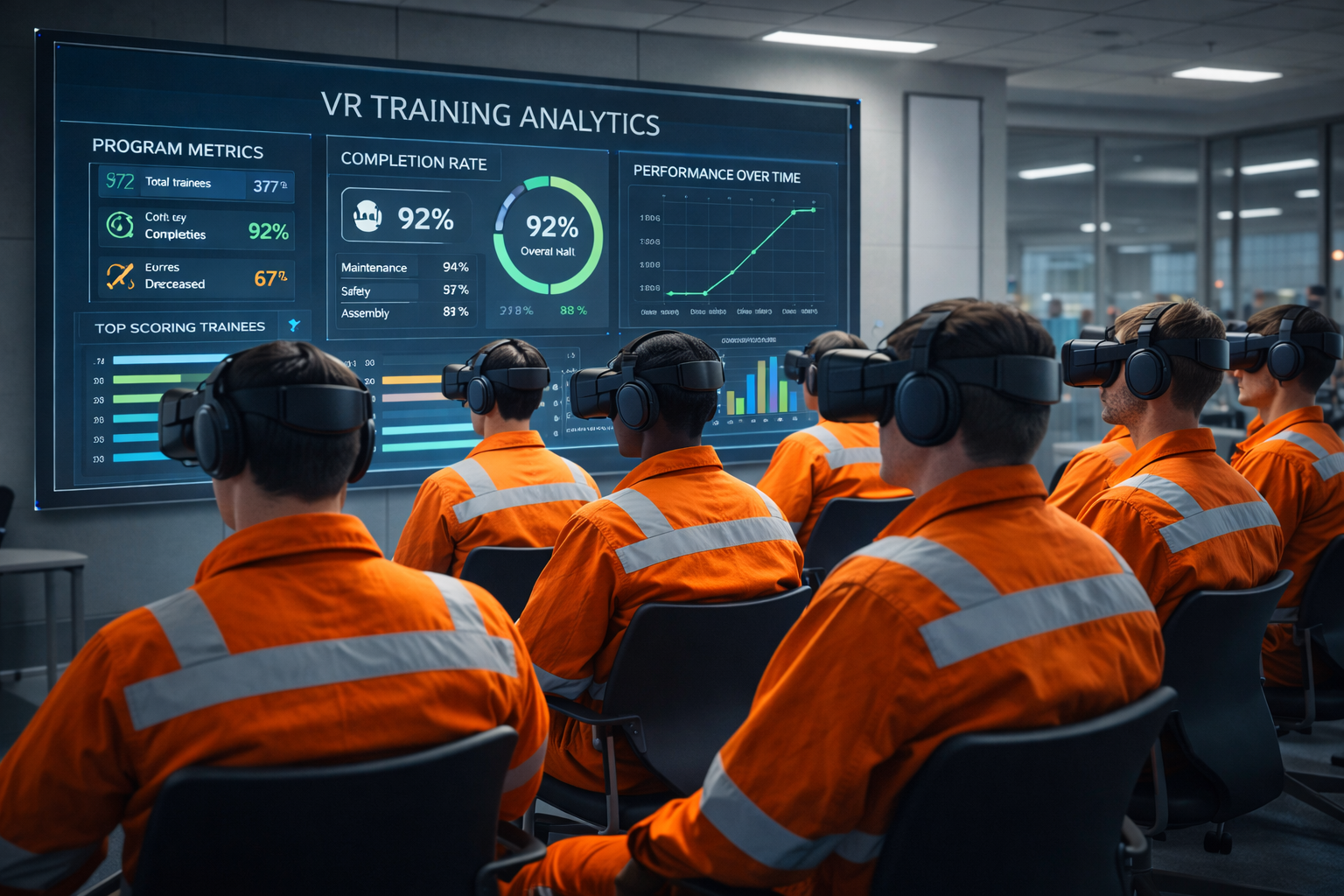
Constant evaluation is essential. Some of the things that the enterprises should observe are completion rates, accuracy of the procedures, reduction of errors, and productivity after the training. VR platform analytics enables managers to measure ROI, optimize modules, and ensure uniform knowledge transfer between locations. According to the industry statistics, organizations with VR analytics are becoming better at operational compliance and expedited preparation for high-risk tasks. With the integration of critical role identification, expert VR development, and performance tracking, the companies can effectively and safely scale VR onboarding programs.
Conclusion
Businesses will be able to design interactive and entertaining modules that simulate real-world activities, sophisticated equipment handling, and processes, so that learners become actively involved. To enhance your workforce preparedness and protection, AuraInteract provides immersive, scalable, and captivating VR training solutions that accelerate onboarding, enhance capabilities, and maintain consistent performance across all global industrial processes.