

Gamified Corporate Training: Boost Engagement & Performance
The conventional corporate training does not generally involve the employees. Long slide presentations, dry compliance training or compulsory videos are occasionally a chore. This contributes to poor learning and low completion rates.

The conventional corporate training does not generally involve the employees. Long slide presentations, dry compliance training or compulsory videos are occasionally a chore. This contributes to poor learning and low completion rates.
This is altered by gamified corporate training. Training is made more interactive, encouraging and productive by including game-based elements like points, badges, challenges and real-time feedback. Gamified learning is becoming a necessity in many progressive companies to enhance engagement and performance.
The Changing Landscape of Corporate Learning
Corporate learning is changing to address the current workforce requirements; engagement, flexibility, and measurable impact are now more than it has ever before.
Declining Engagement in Traditional Training Programs
The problem of decreasing engagement in standard training is a severe issue in many organisations. Employees miss modules or minimal work. E-learning is not interactive through lectures or static e-learning. This has led to poor retention of knowledge and the transfer of skills into the day-to-day job is not common. This lack of engagement nullifies the importance of investments in training.
The Need for Interactive and Motivational Learning Models
To overcome these shortcomings, organisations are considering interactive encouraging forms of training that are compatible with contemporary learners. Gamified training will ensure that the process of learning will be less cumbersome. This change is based on the employee's need for flexible, dynamic and rewarding learning in distributed or remote working teams.
Read More: Why Forward-Thinking CEOs Are Investing in Digital Twin Solutions
Understanding Gamified Corporate Training
Now, let's explore the meaning of gamification in learning and its effectiveness.
What is Gamification in Learning?
Gamification implies the application of game-design features to non-games such as company training. It does not make training a video game in itself. Instead, it introduces such functionality as tracking progress, rewards, levels, challenges, and feedback to make learning more exciting. These aspects motivate trainees to be engaged and remain determined till training is done.
Core Elements of Gamified Training (Points, Badges, Leaderboards, Challenges)
Typical gamification elements include:
● Points - earned for completing modules or tasks.
● Badges / Achievements - visible recognition of milestones.
● Leaderboards or Rankings - friendly competition or recognition among peers.
● Challenges / Quests / Levels - structured tasks that increase in difficulty and reward progress.
These aspects make routine activities interesting, and provide the learner with milestones and an outward sign of advancement, which will enhance motivation.
Why Gamification Works: The Psychology of Motivation
The human mind reacts to the incentives and responses. Learners will feel like they have achieved something whenever they see progress (points, badges). Intrinsic motivation (mastery, competence) and extrinsic motivation (recognition, rewards) are used through game mechanics. Such a mix brings interaction and promotes learning through repetition.
How Gamified Training Enhances Employee Engagement?
Gamified training transfers learning via passive consumption to active participation, and the level of engagement increases.
Active Participation and Real-Time Feedback
Gamified training also allows interactions among the learners as opposed to passive learning. They do jobs, make decisions, receive immediate feedback and see the results instantly. Active participation increases interest and assists in retention. Research findings indicate that gamification learning fosters frequent engagement and enhanced concentration in comparison with the conventional methodology. According to a corporate e-learning survey, gamified learning experiences can increase employee engagement by up to 48% compared with non-gamified training.
Competition and Collaboration in Learning Environments
Gamified training ensures healthy competition and teamwork with leaderboards, team challenges or collaborative quests. With peers, learners can encourage each other to act, work together to resolve problems, or exchange ideas and hints, therefore learning becomes social and interactive. This is a social factor that can contribute to increased completion and improved retention.
Increased Knowledge Retention and Skill Application
Learning that is based on a game in most cases leads to increased retention and skill application. Learners are more likely to remember and use what they learn when they practise in interactive situations rather than the learner passively reading or listening. As an example, gamified e-learning has been proven to enhance the retention rates and strengthen the practical abilities.
Business Benefits of Gamified Training Solutions
In addition to engagement, gamified training provides organisations with real value in terms of productivity, scalability and investment returns.
Improved Employee Performance and Productivity
Gamified learning is useful in ensuring that employees deliver better since it makes the training process more engaging and effective. Based on the recent studies, organisations that apply gamified training tend to record substantial gains in such metrics as the completion of tasks, the onboarding rate, and operational efficiency.
Scalable Learning for Distributed Teams
A large number of organisations are currently functioning in the same place, remote teams or time zone. Gamified training is digital, place-independent and flexible. It allows the learning to be uniform throughout the enterprise and physical infrastructure is not required nor can trainers be assembled to schedule the learning.
Better ROI and Measurable Learning Outcomes
Gamified modules produce statistics: completion rates, challenge performance, time spent, and performance improvement. These are used to measure the training ROI. The organisations are in a position to monitor the engagement, progress, retention and performance boost, which creates an attractive business case to continue investing in gamified learning. One study showed that companies using gamified training saw 22% higher retention rates compared with traditional training methods.
Read More: Why VR Works for Training? Reasons are Here…
Integrating Gamification with AR/VR for Immersive Learning
Gamification with immersive technologies, such as AR/VR, can be used to make an effective, tangible training, that is, to train in a high-risk, technical, or practical area.
Virtual Simulations with Game Mechanics
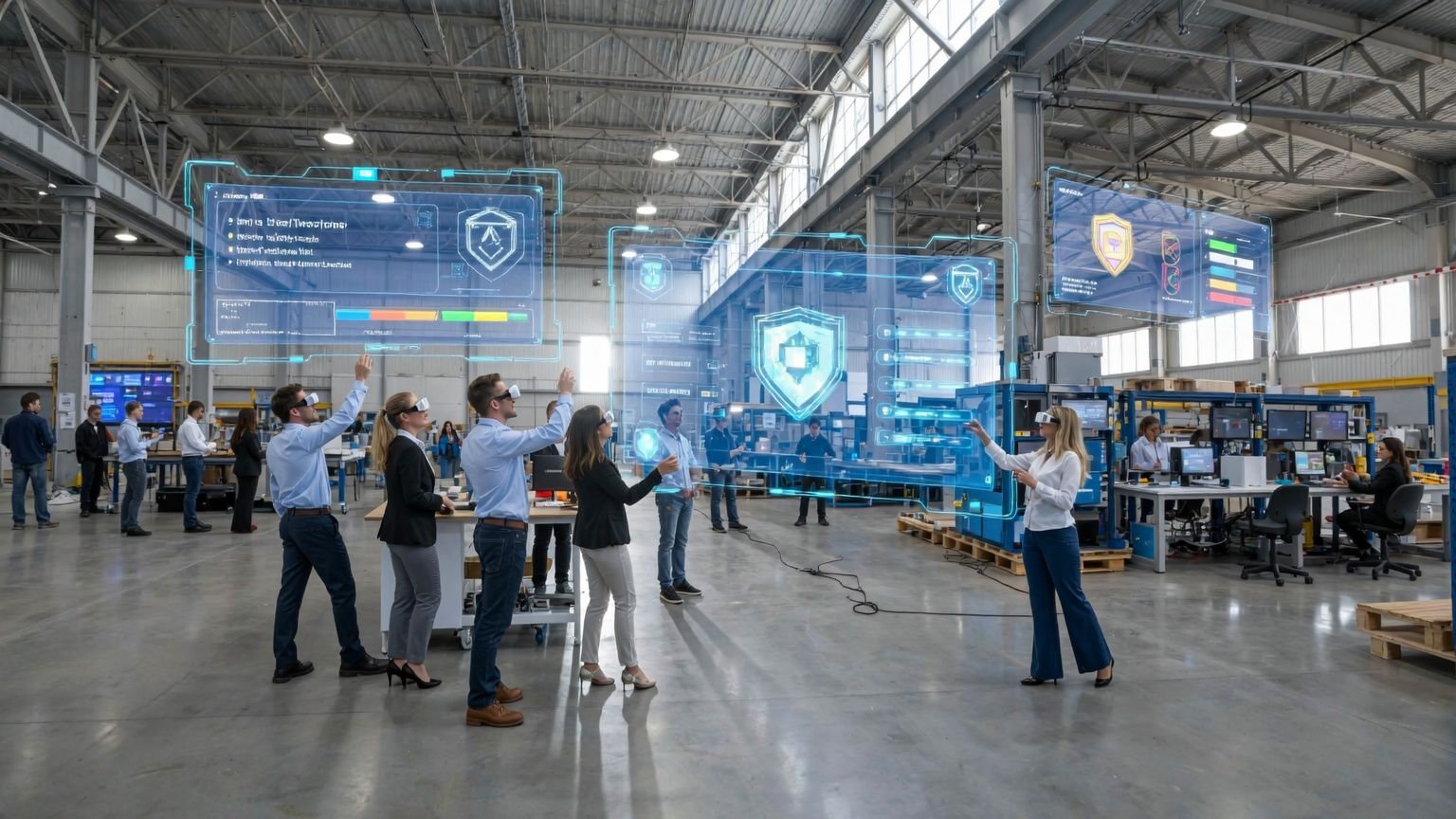
Combining gamified training with VR training solutions, learners get an opportunity to train complex tasks in a safe yet realistic virtual environment. The level, feedback, and point simulations allow the learners to practice and master the skills before they operate on the actual equipment.
Realistic Scenarios for High-Impact Corporate Learning
Gamified training in AR/VR provides the opportunity to simulate the real world, that is, to simulate the work of machinery or a safety drill or a service procedure without any danger. The real-world simulated experience assists the trainees in internalising the procedures, learn through doing and improving the transfer of the skills to the job. Organisations can also use digital twin solutions for enterprises to make a precise virtual representation of assets or workflows to be trained upon by organisations.
Success Stories Across Industries (Manufacturing, Aviation, Healthcare)
Immersive gamified training is helpful in many industries, such as manufacturing, aviation, and healthcare. As an illustration, VR machines are gamified to teach technicians how to work on assembly lines in manufacturing companies. Aviation organisations emulate cockpit or maintenance situations, whereas the healthcare providers emulate patient-care guidelines. This kind of cross-industry adoption underlines the flexibility and influence of gamification.
In order to construct and implement these solutions at scale, organisations may engage the services of a Top AR VR development company or may even hire dedicated AR/VR developers to design bespoke modules to meet the needs of the enterprise.
How to Implement Gamified Training in Your Organisation?
It is necessary to plan, be objective-oriented, and make appropriate design decisions to be successful in its implementation.
Identify Key Learning Objectives and KPIs
You should start with the definition of what you want to accomplish. Is it compliance with safety, mastery of technical skills, speed during onboarding, customer-service excellence, or knowledge of products? Establish quantifiable KPIs, e.g. completion, error reduction, time-to-proficiency, customer satisfaction. Clarity enables the game to be developed with a purpose that will be effective in assessing success.
Design the Right Game Mechanics for Your Workforce
Select elements that are relevant to your workforce: depending on culture and desired behaviour, use points, badges, challenges, leaderboards or team quests. Leaderboards can be effective in a competitive sales team. Group obstacles might be more successful in the case of collaborative teams. Apply feedback loops and levels, progress tracking and rewards that are relevant to the learners and also are aligned to the organisational goals.
In case you are developing immersive modules, you can recruit a gamified training development partner to assist in designing interesting game mechanics with learning material.
Partner with Experienced AR/VR Developers for Scalable Delivery
In case of advanced or large-scale training, particularly technical, safety-critical, or practical skills, it is a good idea to resort to collaboration with seasoned AR/VR developers. It assists in ensuring high fidelity simulations, consistent performance, natural UX and simpler deployment by teams. Most companies enlist the help of experts to develop scalable, bespoke, immersive learning systems.
Conclusion
Corporate training in the form of gamification is not a sham, it is an effective tool in changing learning, engagement, and performance within organisations. The ability to combine game play with learning goals allows businesses to transform boring training into an interactive, inspiring and efficient training programme. Gamified training is even more effective in the case of technical or safety-critical or hands-on training in combination with immersive technologies such as AR/VR and digital twins.
To consider the future of organisations, gamified training development or collaboration with a Top AR VR development company may be the key to performance improvement, engagement, and the introduction of a continuous learning culture.