

Digital Twin vs Traditional SCADA Systems: What Oil & Gas Companies Should Know
The oil and gas sector is at a very pivotal point in its course in 2026. It has several challenges ahead of itself due to geopolitical tensions and energy transition pressures, along with the growing demand for operational efficiency.

The oil and gas sector is at a very pivotal point in its course in 2026. It has several challenges ahead of itself due to geopolitical tensions and energy transition pressures, along with the growing demand for operational efficiency. Traditional monitoring systems, such as SCADA, have worked great for decades. However, companies now need advanced solutions to stay competitive due to aging infrastructure and exploding data volumes. Digital twin solutions for enterprises represent a great step.
They can bring together real-time data with smart simulations. This can help monitor and predict, as well as optimize every aspect of operations, like upstream exploration and downstream refining. This article takes a look at the details of digital twins as compared to SCADA. Oil and gas leaders can use this as an actionable insight to understand both differences and benefits.
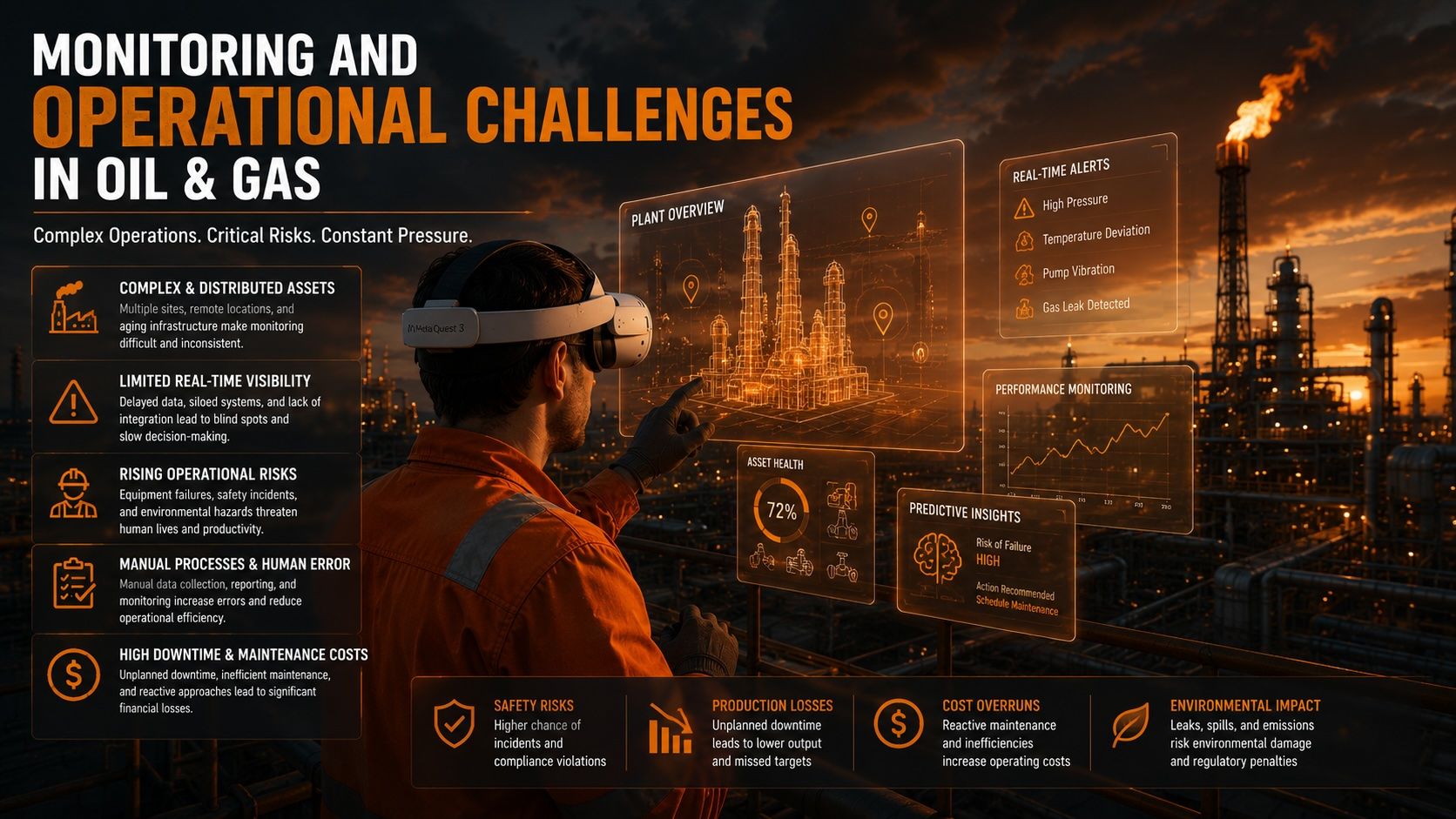
Monitoring and Operational Challenges in Oil & Gas
Monitoring and operational challenges in oil and gas necessitate a smarter solution. Let us first look at how these arise:
Complex Infrastructure and Distributed Assets
Oil and gas companies have some of the world’s most intricate and far-flung infrastructures. This includes deepwater rigs that exist thousands of miles offshore, along with extensive pipeline networks that spread across deserts/ oceans and refineries that process millions of barrels every day. These assets are both distributed and work in extreme conditions of corrosive environments and high pressures.
There is, thus, a greater chance of vulnerabilities and mechanical failures, along with environmental hazards and human error. Constant oversight must go into managing such complexity. Even so, physical inspections are both costly and time-consuming.
Need for Real-Time Monitoring and Decision Making
Real-time monitoring is something that cannot be overlooked in an industry where milliseconds matter. This is needed to avert disasters and capitalize on opportunities. Fluctuating oil prices and sudden weather events, along with equipment anomalies, can cause massive losses if they are not addressed on time.
Decision-makers in this regard need alerts as well as contextual intelligence. This means integrating weather data and historical trends, as well as predictive models, to create better strategies.
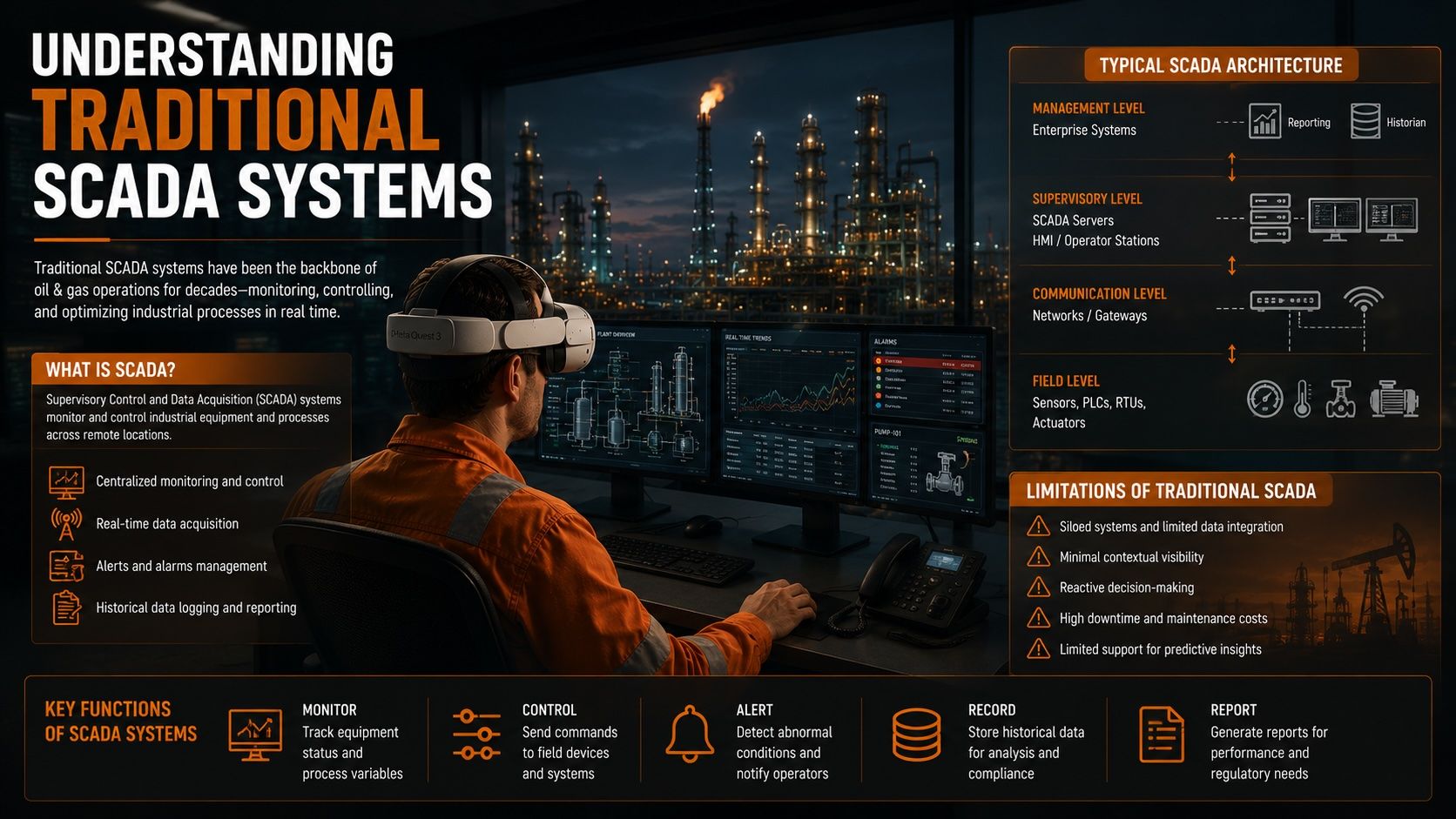
Understanding Traditional SCADA Systems
Before moving any further, let us have a look at how traditional SCADA systems have been serving the oil and gas industry:
What SCADA Systems Do in Oil & Gas Operations
Supervisory Control and Data Acquisition (SCADA) systems have been the default solution of oil and gas control rooms for several decades. They give a centralized platform for overseeing vast networks of sensors and valves, as well as pumps and compressors. SCADA collects data from wellheads and drilling rigs to monitor pressure and flow rates in upstream operations.
These allow remote adjustment wherever needed to boost output. Misstream applications focus on pipeline integrity. SCADA can detect anomalies like pressure drops that show leaks or even automate valve shutoffs. Refineries use SCADA in the downstream status for process control and for ensuring safe distillation and cracking under precise parameters. SCADA components communicate with each other through protocols like Modbus and DNP3.
Limitations of SCADA in Modern Industrial Environments
SCADA’s architecture reveals cracks in today’s hyper-connected data-driven era, even if it has continued to be a reliable system. It is made of real-time control instead of deeper analysis, so it excels at the present moment. However, it cannot work with what may happen next. Cybersecurity threats have soared high, up to 110% every year in the last 3 years.
Attacks like these can average about $6.8 million per incident. This can exploit SCADA’s legacy protocols since they are vulnerable to remote hacks. Scalability issues also arise with exploding IoT sensor data. This can overwhelm bandwidth-limited networks and cause latency in large-scale deployments. On top of this, static dashboards do not have the interactivity for scenario testing. This forces engineers to perform time-intensive manual simulations. These gaps mean prolonged downtimes and inefficient resource allocation in volatile oil and gas environments.
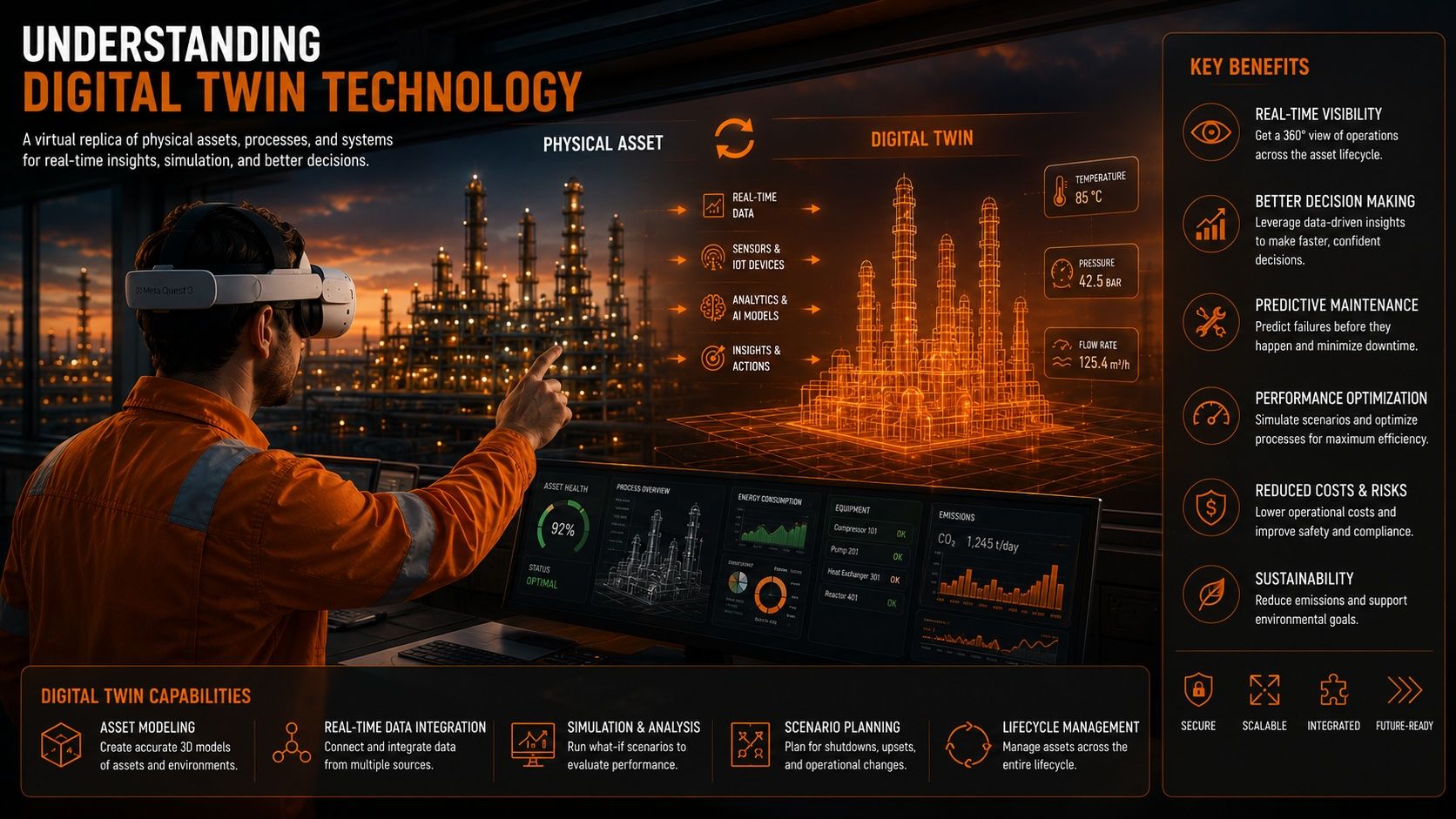
Understanding Digital Twin Technology
Now, we try to understand what digital twin technology is and how it fits in this context:
What is a Digital Twin in Industrial Operations
A digital twin is a high-fidelity virtual replica of a physical asset, process, or system at the core. It is continually updated with real-time data from IoT sensors and historians, as well as operational feeds. In industrial operations like oil and gas, it can range from individual components like turbines to entire value chains, like offshore platforms or reservoir models.
The way was paved for the adoption of digital twins when NASA used them for spacecraft monitoring. Now, it can make use of cloud computing and edge processing, along with AI for accuracy. Digital twins are not static models, which means they evolve to reflect wear and environmental stresses, as well as operational tweaks in virtual space.
How Digital Twins Combine Data, Simulation, and Analytics
Digital twins have the potential to generate an intersection of data ingestion and simulation, and machine learning analytics to enable actionable foresight. Sensor data is fed to 3D models created on the basis of CAD and BIM data. AI algorithms are able to identify patterns such as early fatigue on drill bits, whereas generative models are able to predict scenarios such as what-if events such as hurricane impact on platforms.
This relationship has enhanced recovery of hydrocarbons by up to 3% in oil and gas by optimization of reservoir simulation, which is observed in actual implementation.
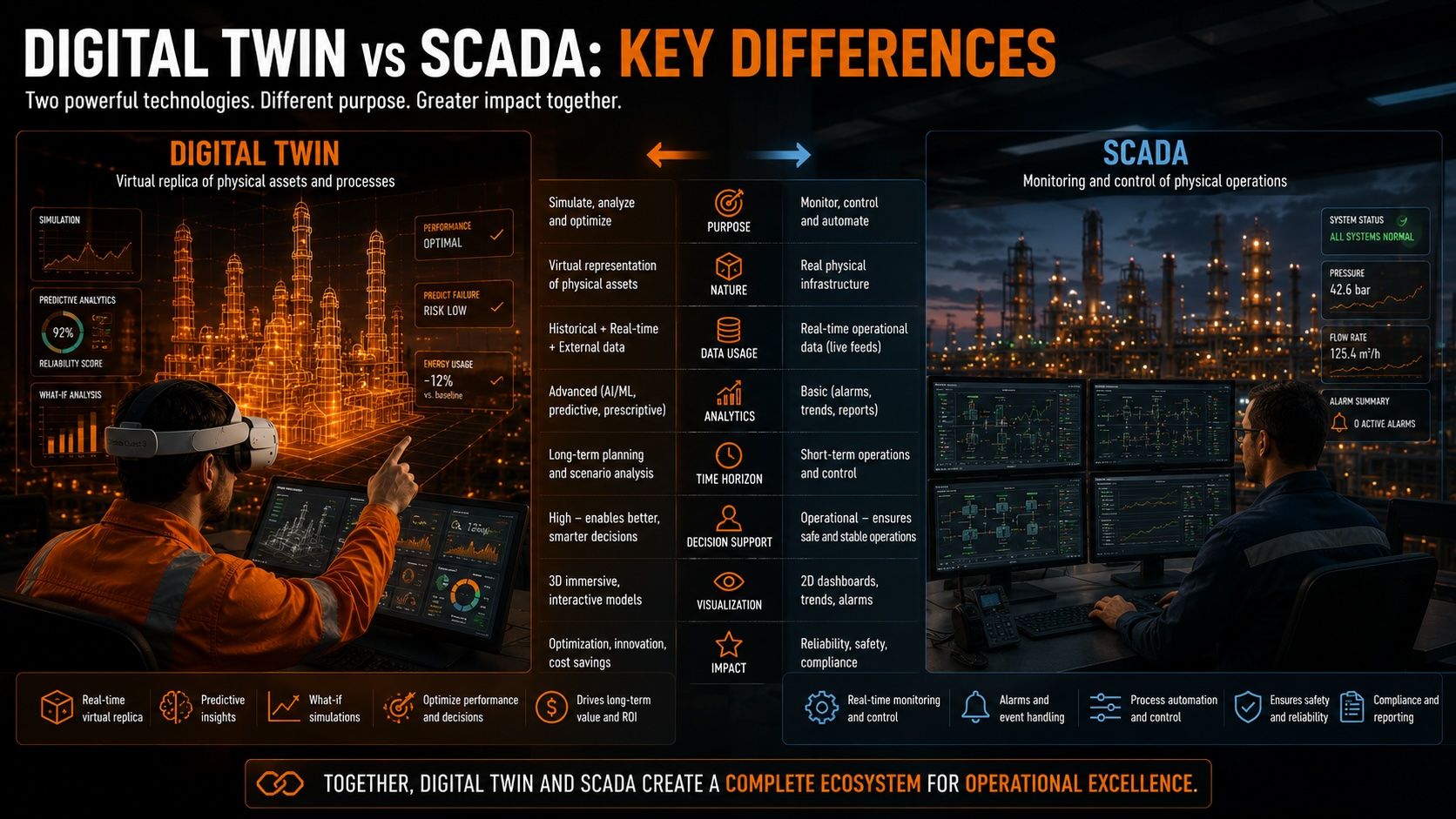
Digital Twin vs SCADA: Key Differences
Digital twin and SCADA have some key differences that make them variably suitable. Let us have a look at this:
Real-Time Monitoring vs Predictive Simulation
SCADA is most appropriate in the case of real-time monitoring. It scans the device on a periodic basis, say every few seconds, to indicate deviations and raise alarms. Nevertheless, it is responsive in nature, in the sense that it notifies you after the occurrence of the event has taken place. Digital twins are generated on this weakness by overlaying proactive simulations on real-time data.
In the case of an oil and gas partner with a Top AR VR development company, this predictive benefit implies that entire drilling projects can be simulated and the wear of the bits or blowouts can be prevented.
Static Data Visualization vs Interactive Asset Modeling
SCADA’s HMIs provide 2D dashboards with gauges and trend lines. These are functional yet limited for spatial comprehension. Digital twins provide immersive 3D/4D models that are navigable via VR, where users drill into microstructures or zoom across facilities. Firms can hire Unity 3D developers for AR/VR projects to overlay sensor data on mobile AR views. This empowers field technicians with holographic guides.
Reactive Maintenance vs Predictive Maintenance
SCADA is used as an addition to run-to-fail or planned maintenance. It responds to such thresholds as increasing vibrations. Digital twins move to prescriptive paradigms based on anomaly detection and digital threads to prescribe interventions. This is one of the key lessons: a 15-minute downtime may result in the loss of up to $150,000 in production.
Benefits of Digital Twins for Oil & Gas Enterprises
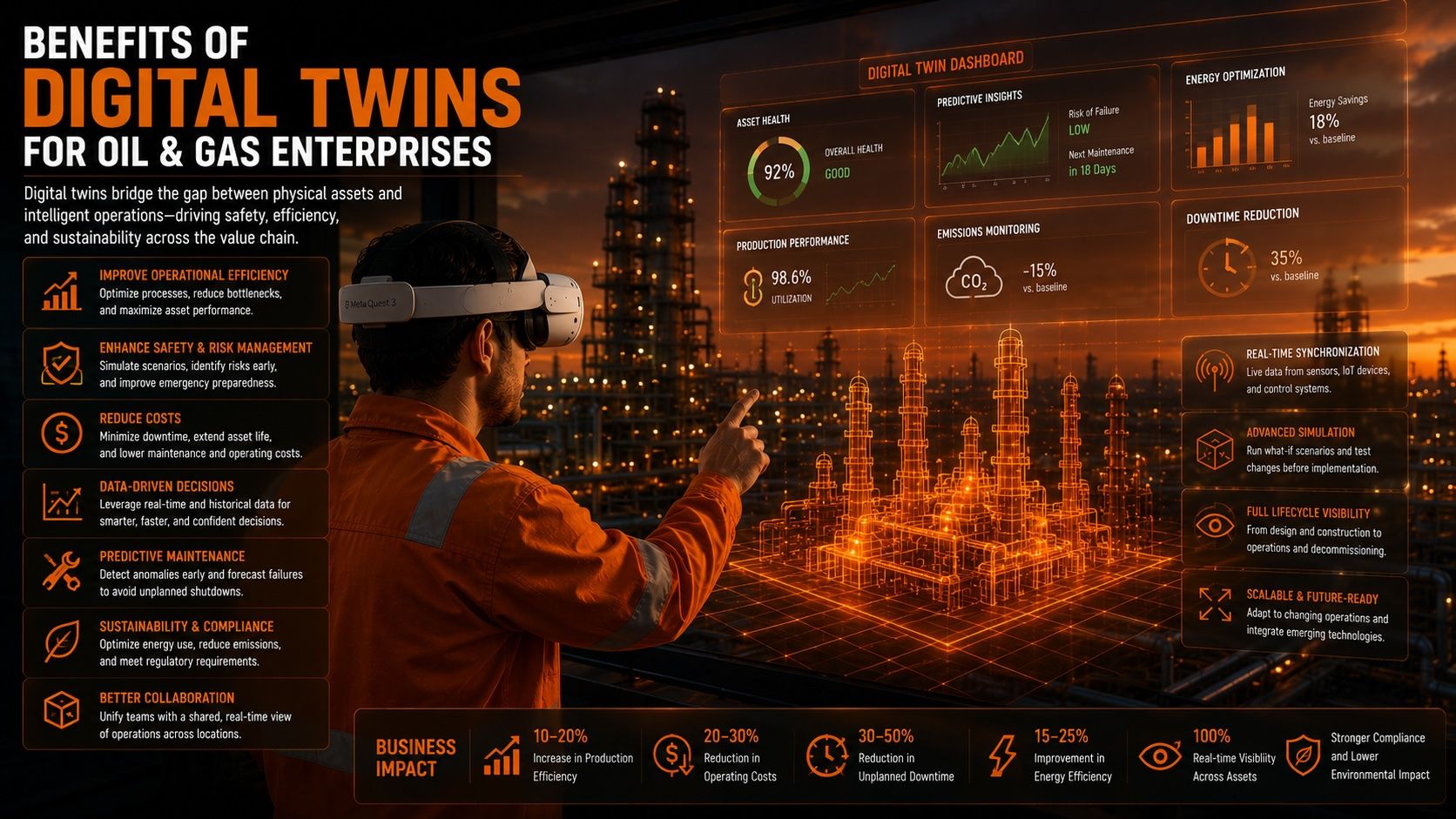
Now, we look into some of the unique benefits that digital twins provide to oil and gas enterprises:
Predictive Maintenance and Reduced Downtime
Digital twins are able to detect deviations at a much earlier stage than thresholds through continuous baselining of asset behaviors. This allows proactive swaps, preventing cascading failures. Repair sequences are simulated by operators as a way to reduce experimentation on live equipment.
Better Asset Performance and Optimization
Real-time KPI dashboards within twins help optimize throughput. For example, adjusting compressor speeds greatly boosts equipment efficiency by 15%. Reservoir twins refine injection strategies. This further extends field life and squeezes marginal gains from mature assets, all while emissions tracking aids.
Data-Driven Decision Making
Twins democratize insights through collaborative platforms. Here, executives can visualize portfolio risks, and engineers can test optimizations. Virtual reality training for manufacturing embeds here to immerse crews in gamified oilfield drills.
Implementing Digital Twin Solutions in Oil & Gas
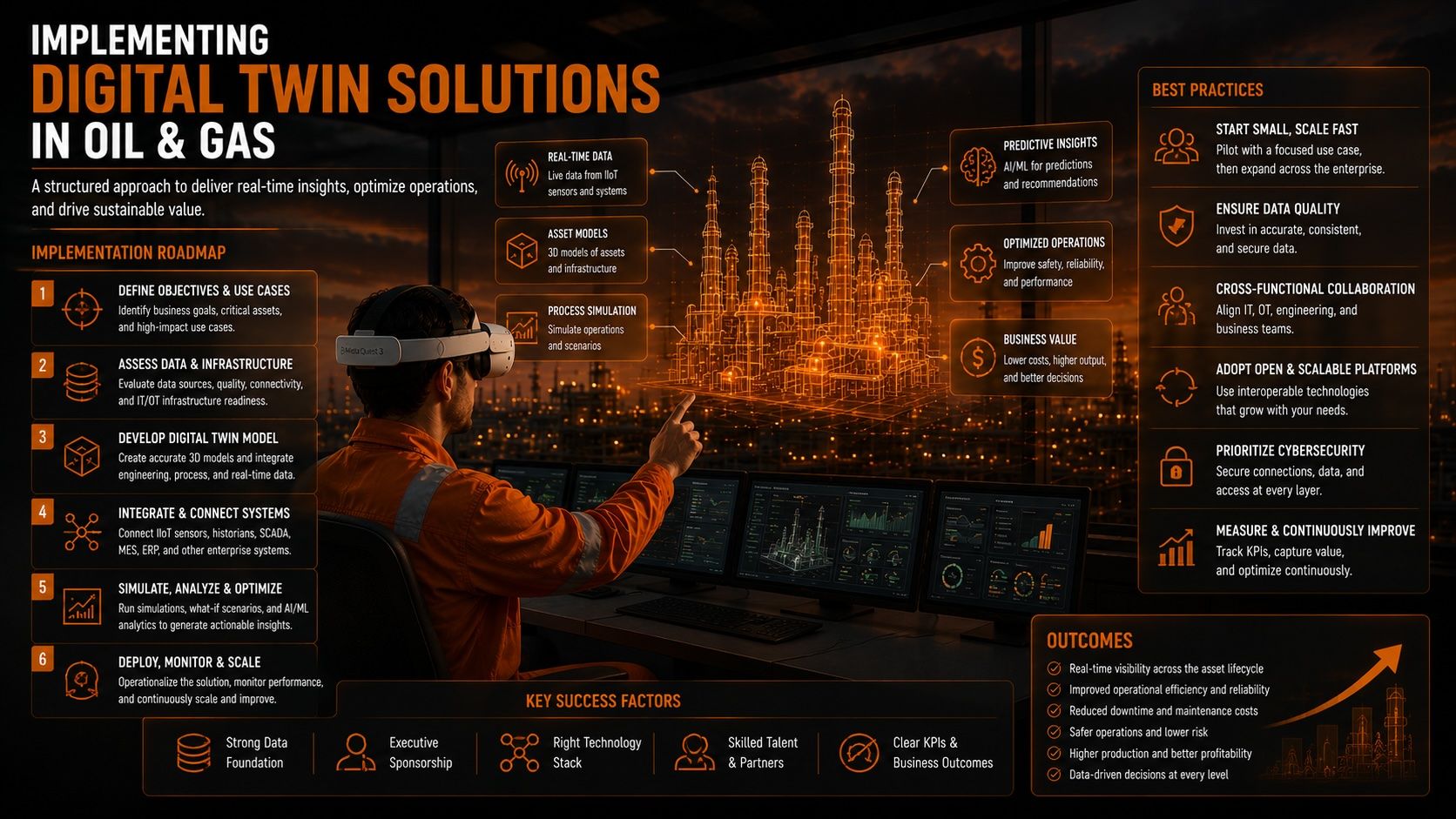
Here is how the implementation of digital twin solutions in oil & gas works:
Identify Critical Assets and Processes
The first step would be a maturity assessment. This would be the case with audit sensors in high-value assets such as FPSOs or turbo-machinery. These are ranked by failure impact, using RIMAP scoring. Data quality audits are guaranteed to provide maximum fidelity in order to establish a foundation of credible twins.
Integrate Digital Twins with Existing Systems
The SCADA feeds can be linked to twin platforms such as Siemens Xcelerator or AWS IoT TwinMaker via seamless APIs. This enhances legacy data with expensive rip-and-replace AI. The hybrid edge cloud architecture addresses the latency-sensitive operations, whereas the standards such as OPC UA provide interoperability.
Scale Across Operations and Facilities
Digital twins pilot on one rig or pipeline segment to validate ROI before enterprise rollout through modular micro-twins that will federate into macro-models. Furthermore, gamified training development shall help upskill teams during scaling. This can be done through leaderboards and scenarios to speed up adoption across global footprints.
Conclusion
Oil and gas companies can go for enduring success in a decarbonizing world by moving from SCADA’s reactive vigilance to digital twins’ predictive prowess positions. Strategic adoption of digital twins with expert integration will define industry leaders through 2030 and beyond. Aura Interact provides VR Training for the Oil & Gas Industry to modernize operations and allows practical innovation.